


Meet Trace3's Partner, Dynatrace
Dynatrace® helps companies transform the complexity of modern digital ecosystems into a competitive advantage with AI-powered observability and complete automation. Our all-in-one platform provides answers — not just data — about the performance of applications, the underlying infrastructure, and the experience of all users. That’s why many of the world’s largest enterprises trust Dynatrace to modernize and automate cloud operations, release better software faster, and deliver unrivaled digital experiences.
Partnership Overview
Together with Trace3, Dynatrace empowers Fortune 1000 enterprises to achieve unparalleled success in their digital transformation journeys. Trace3’s deep expertise in cloud, application modernization, and digital transformation perfectly complements the Dynatrace unified observability and security platform, powered by AI for real-time auto-discovery, precise root-cause analysis, and automated remediation.
This partnership delivers end-to-end solutions — from onboarding and architecture design to AIOps and business analytics — that align observability with business outcomes. By combining the Dynatrace AI-powered observability platform with Trace3’s strategic guidance, organizations can accelerate cloud adoption, reduce operational noise, and continuously optimize hybrid and cloud-native environments for innovation and growth.

Learn More About Dynatrace and Trace3:
2026 Observability Challenges
White Paper
Abstract
Enterprises face a rapidly changing environment driven by AI and agentic systems. Organizations that don’t modernize their observability practices risk deploying AI they can’t govern, validate, or measure, creating downstream impacts across operations, security, and financial performance.
Agentic AI solutions require strong governance and operational discipline to succeed in production. Traditional, fragmented monitoring approaches no longer provide the deep insight needed to understand AI behavior at scale.
These workloads demand end-to-end visibility across metrics, events, logs, and traces. As a result, many organizations face a growing gap between agentic AI ambition and operational readiness.
Compounding this challenge, more than two-thirds of agentic AI decisions still require human verification. While agentic AI can both increase and help manage complexity, particularly in IT operations and DevOps, leaders must establish a clear observability strategy to ensure confidence, control, and measurable outcomes as AI moves into production.
The four primary observability challenges Trace3 sees clients facing in 2026 are:
-
Unsustainable tool sprawl resulting in fragmented visibility and rising costs
-
Incident volume and alert noise exceeding human team capacity
-
Architectural complexity outpacing operational insight
-
Rapidly advancing AI expectations without equivalent governance and validation mechanisms
Technology leaders in 2026 have the opportunity to evolve their observability practice to address these challenges and capitalize on agentic AI opportunities within their organizations.
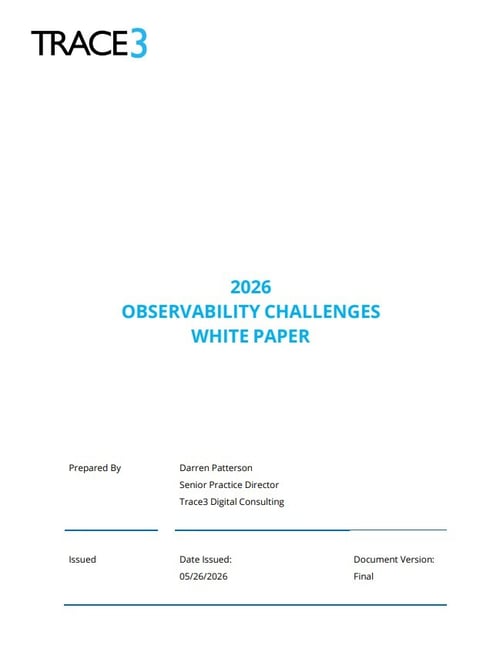
Click on image to view the white paper.